In October 2025 I started as the inaugural artist-in-residence at EthicsLab in the Neuroscience Institute, University of Cape Town. This builds on my previous work combining art and research in the field of emerging technologies in healthcare with my project Bone Flute, the output of a research fellowship with the Future Hospitals team at HUMA, the Institute for Humanities in Africa at UCT. At EthicsLab I’m getting to know the work of the institute while scoping out a few creative interventions I have in mind, and developing a wider programme for engaging artists with work here.
Category Archives: EthicsLab
Southern Scifi predictions – Sleep Dealer made real in Japan
I was reading an article on Rest of World recently about shelf-stocking robots in Japanese convenience stores which are monitored remotely by workers in the Philippines, and it struck me how similar it is to the premise of the Mexican scifi movie Sleep Dealer (2008).
In this real world scenario in 2025, Tokyo-based startup Telexistence has been supplying robots to around 300 Japanese stores over the last few years, which are monitored 24/7 by workers in Manila supplied by Astro Robotics. These workers each manage about 50 robots, and can correct mistakes – if a robot drops something, for example. This system responds to high labour costs in Japan, “allowing physical labor to be offshored” as Astro Robotics’ founder Juan Paolo Villonco told told Rest of World.
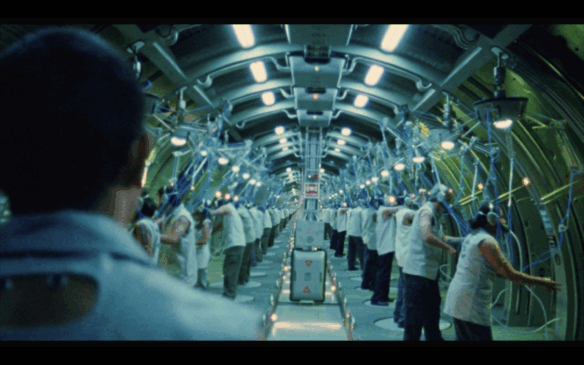
This is the plot of a near future US-Mexico in Sleep Dealer, directed by Alex Rivera, in which the ‘problem’ of immigration to the US is solved by having workers in Mexico operate remote-controlled robots on construction sites and in homes in the US, so that their bodies stay behind the border but their labour can travel. The VR sweat-shops they work in are called ‘sleep dealers’ because of how exhausting the work is.
I first saw Sleep Dealer when I rented it from a video store not longer after it came out, with no introduction to it – it was displayed like any B-movie in the Scifi/Horror section. It’s stayed with me ever since as such a clever imagining of a future world with exploitation enabled by technology; and also in how it pits hackers who repurpose high-tech devices to fight US imperialism. There’s a lot in it about technology as a battle ground for oppression and resistance. It’s also an example of what can be called ‘Southern Scifi’ – science fiction informed by our particular experience in the South of the likely applications of technology aligned with a history of global power relationships.
And it, and the current real-world example in Japan-Philippines, draws attention to the Mechanical Turk-ing involved in many high-technology application – the humans who make it work, often employed from parts of the world where labour is cheap and regulations lax. This comes up for AI, as explored in this recent interview with Karen Hao on her book ‘Empire of AI‘ (2025).